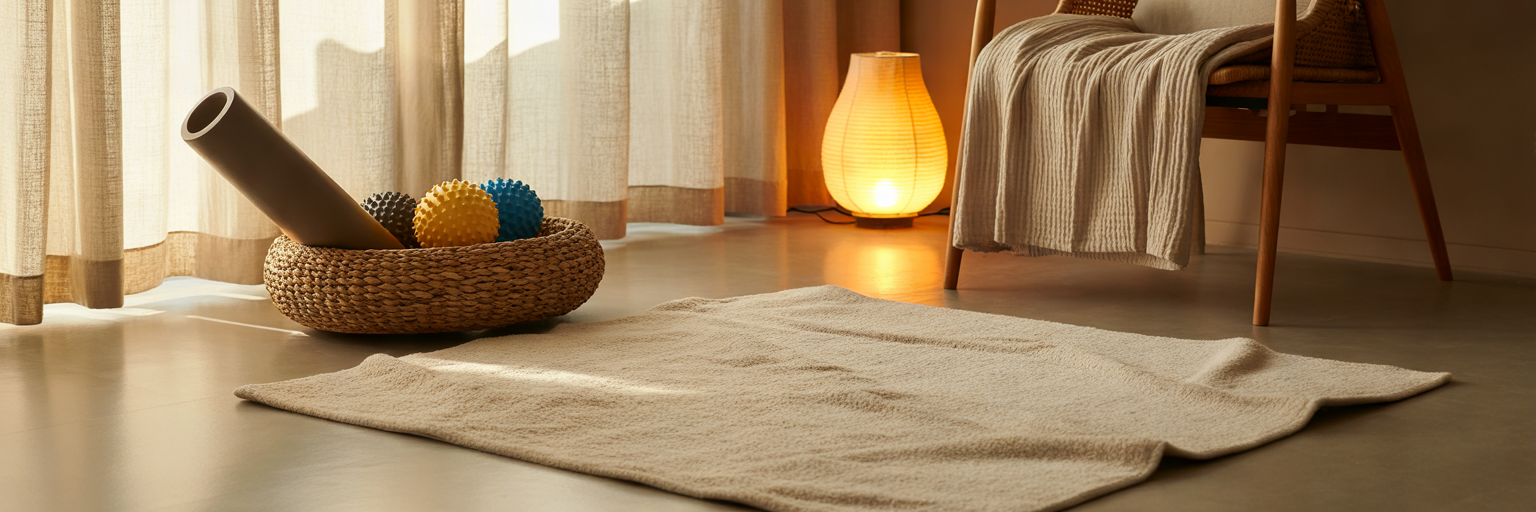
Even when your body is resting on the sofa after a long day, elevated evening cortisol and low-grade sympathetic nervous system activation can keep muscle fibres braced and delay cellular repair. Building a dedicated passive recovery setup at home gives your nervous system the exact environmental signals required to shift from physical tension into genuine restorative rest.
Why Your Body Needs a Passive Recovery Setup at Home
You know the exact physical sensation of arriving home at six in the evening after a long day at a desk, a brisk coastal walk, or a heavy resistance session at the gym. Your legs feel heavy, your lower back carries a dull ache, and your shoulders sit slightly closer to your ears than they did at breakfast. Most of us assume that collapsing onto the living room lounge with a tablet or television remote counts as physical recovery. In reality, your musculature and nervous system are experiencing two entirely different things.
Sitting motionless under bright overhead downlights while scrolling through evening news keeps your sympathetic nervous system quietly switched on. The blue light hitting your retinas and the cognitive stimulation of the screen tell your brain that the workday is still in progress. Consequently, your adrenal glands continue to trickle cortisol into your bloodstream, which keeps your myofascial tissues subtly braced and restricts the peripheral blood flow needed to clear metabolic waste from fatigued muscles. You are physically stationary, yet biologically stalled in a low-level stress response that delays cellular repair and flattens deep sleep architecture.
Many people try to fix this evening stagnation by ordering miscellaneous massage guns, posture correctors, or heat wraps that swiftly end up buried at the back of a linen cupboard. Whenever a recovery routine requires you to rummage through a closet, untangle power cords, or move living room furniture, your fatigued evening brain will simply skip the habit. A functional passive recovery setup at home eliminates that behavioural friction by giving your body a permanent, zero-effort place to down-regulate. As we detail in our guide to passive recovery tools for athletes after training, the true purpose of passive modalities is to coax your physiology out of post-exercise tension without demanding another ounce of physical exertion or willpower. Before spending money on complex hardware, some Australians also establish an objective internal baseline through services like Mito Health, which tracks blood biomarkers and inflammation patterns so you understand what is actually happening inside your body rather than guessing which recovery gap needs attention.
Designing the Physical Footprint and Sensory Environment
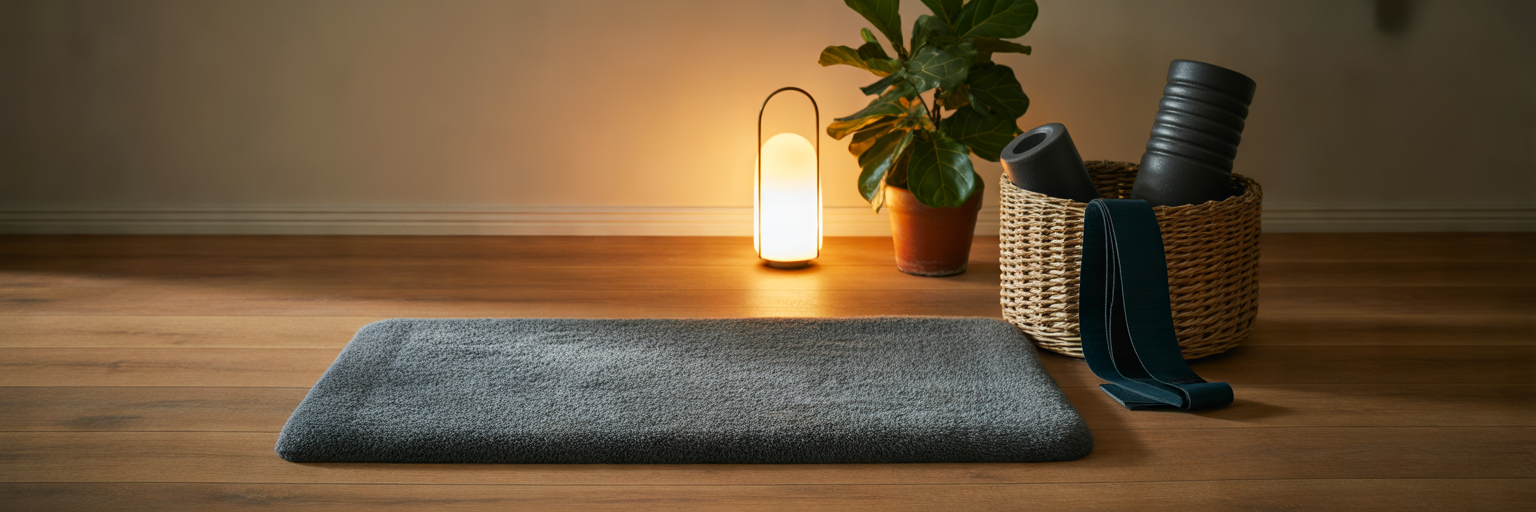
Your autonomic nervous system constantly scans your physical surroundings for safety and rest cues long before you touch a piece of recovery equipment. If your designated stretching corner sits next to a pile of unfolded laundry, a buzzing Wi-Fi router, or a cluttered home office desk, your visual cortex registers unfinished tasks. Similarly, if you have to shove a heavy coffee table aside and unroll a yoga mat from a tight closet every night at eight o'clock, those small micro-decisions create enough mental resistance to derail the habit within a fortnight.
Creating an effective budget home recovery space starts with claiming a permanent footprint of roughly six feet by four feet, or about 1.8 metres by 1.2 metres, in a quiet corner of a spare room or bedroom. The single most important rule of this footprint is that your floor mat stays permanently rolled out. When the mat is always waiting for you on the floor, stepping onto it requires zero cognitive effort, turning the transition from upright activity to horizontal rest into an automatic physical reflex.
Once the floor space is claimed, your next priority is controlling the photonic environment above your head. Standard Australian residential downlights often emit crisp white light between 4000K and 5000K, which mimics midday solar wavelengths, suppresses melatonin secretion, and keeps evening cortisol artificially high. Switching off those overhead fixtures and placing a small floor lamp fitted with a warm bulb rated below 2700K at eye level or lower immediately alters your neurochemistry. Exploring dedicated circadian lighting options from our BlockBlueLight directory listing allows you to bathe that six-by-four-foot zone in amber or red-shifted hues that signal your suprachiasmatic nucleus that the active day is finished.
The tactile details within arm's reach of your mat complete this sensory shift without costing a fortune. Swapping slippery synthetic activewear for breathable natural cotton or washed linen helps skin temperature regulate naturally as you lie down. Placing a single leafy indoor plant in the corner softens the visual geometry of the room, while an open woven seagrass or timber basket right beside the mat holds your basic accessories neatly in one spot. You can reach into an open basket with your eyes half-closed without breaking your calm state. By removing visual clutter, softening the light spectrum, and keeping the floor mat permanently accessible, your spatial design accomplishes the heavy lifting of nervous system regulation before you spend a single dollar on electronics.
Allocating Your Budget Across Foundational Tools First
With a calm, low-light corner permanently established, the temptation to immediately fill it with expensive electronic hardware can be strong. Walk into any wellness forum and you will see people spending three thousand dollars on advanced recovery systems before they have proven they will lie still on the floor for twenty minutes four nights a week. High-ticket equipment cannot fix an inconsistent routine, and an unused device sitting in the corner only becomes an expensive source of buyer's remorse.
A far smarter approach is to cap your initial outlay between $100 and $300 AUD and direct every dollar toward durable, mechanical tools that rely on gravity and bodyweight. That modest starter budget easily covers a thick, high-density exercise mat that insulates your spine from hard timber or tile floors, a firm EVA foam roller that will not flatten over time, a pair of rubber myofascial trigger-point balls, and a simple woven cotton stretching strap. In our companion breakdown on how to build a budget passive recovery setup at home, we examine how these foundational pieces work together to release mechanical stiffness without requiring a wall outlet.
The physiology behind these simple items is straightforward and reliable. When you lie over a firm foam roller or rest a tight glute or thoracic muscle against a trigger-point ball for ninety slow seconds, that sustained mechanical pressure stimulates sensory mechanoreceptors called Golgi tendon organs embedded within your fascia. Those receptors send an inhibitory signal back to your spinal cord, instructing the tight muscle spindles to let go of their protective grip. Following that slow tissue release with gentle, strap-assisted hamstring or hip opening while breathing slowly through your nose stimulates the vagus nerve. Your heart rate drops, blood pools gently back toward your core organs, and your parasympathetic nervous system takes the wheel.
To make this $100 to $300 investment pay dividends, anchor your twenty-minute floor session to an existing daily transition that never changes. Stepping onto the mat immediately after your warm evening shower, when your core temperature is already beginning its natural nocturnal drop and your muscles are warm, creates a powerful Pavlovian association. Within three weeks of repeating that exact sequence under warm 2700K light, your nervous system begins to down-regulate the moment your back touches the mat. Proving to yourself that you will show up in this space every evening with basic mechanical gear is how you earn the right to upgrade to higher-ticket recovery technology later on.
Evaluating Thermal and Electromagnetic Systems When You Scale Up
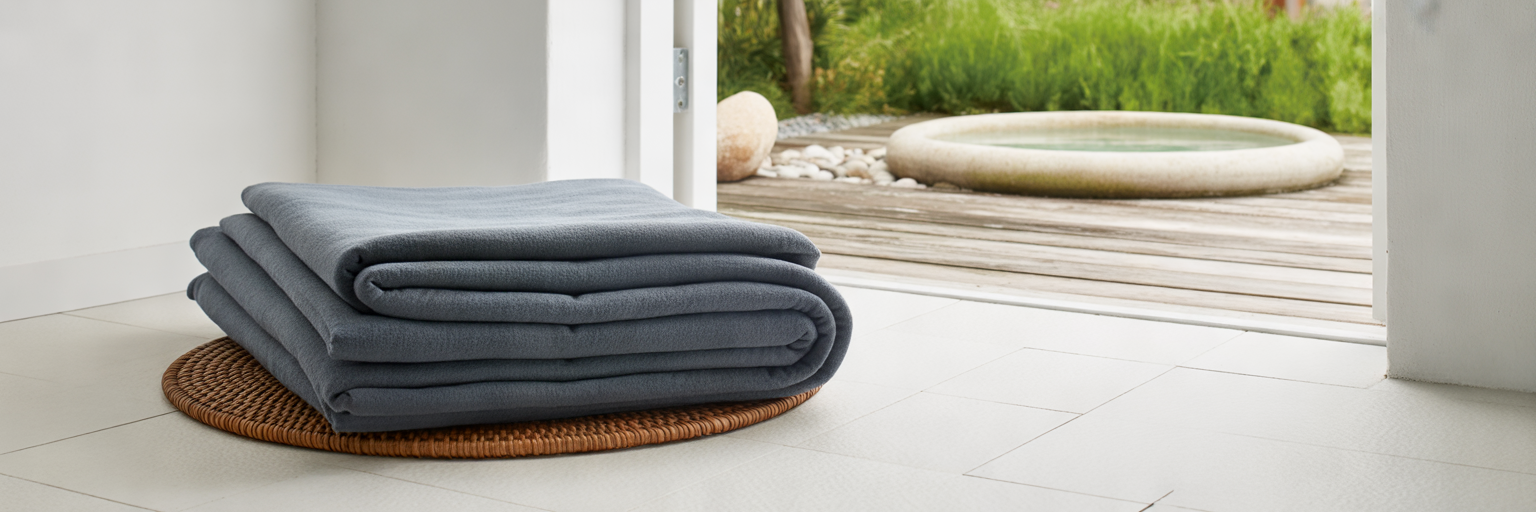
Once your evening floor habit is locked in and you begin researching higher-tier home recovery equipment Australia offers, the market shifts from $50 foam rollers to specialised systems ranging from $500 to well over $5,000 AUD. At this price point, marketing language often blurs into vague promises of cellular rejuvenation. Making a confident buying decision requires stripping away the promotional gloss and looking strictly at how each technology interacts with human physiology and how it fits into a real Australian home.
If your primary evening challenge is lingering muscular guarding and an inability to warm up cold, stiff joints before sleep, an infrared sauna blanket Australia buyers frequently choose offers a compact entry into thermal therapy. Unlike a traditional timber cabin sauna that heats the surrounding air, a sauna blanket uses conductive far-infrared heating elements wrapped directly around your body to raise core temperature, trigger peripheral vasodilation, and induce a heavy sweat while you lie flat on your existing mat. For readers weighing whether conductive heat or cold water immersion makes more sense for their physiology, our analysis of cold plunges versus infrared sauna blankets breaks down how each extreme drives autonomic recovery differently.
When summer humidity arrives or when heavy endurance training leaves your legs throbbing with acute post-exercise heat, adding thermal load is the last thing your body wants. On warm evenings when restless, overheated limbs disrupt your transition into sleep, passive cooling textiles like Ice Blankets draw excess surface heat away from tired tissues while you rest horizontally on your mat or bed without requiring plumbing or water upkeep. Conversely, if you are searching for the best cold plunge Australia has for rapid post-training vasoconstriction and vagal nerve conditioning, dedicated immersion systems such as Plunge Chill deliver precise, chiller-regulated water temperatures that strip thermal load out of deep muscle bellies in three minutes flat, though they demand an outdoor deck, garage, or wet area with reliable drainage.
Not every upgrade relies on shifting your body temperature. Many buyers over forty reading PEMF mat reviews are looking for a gentle, non-thermal way to calm an overactive nervous system without sweating or shivering. Pulsed electromagnetic field mats emit low-frequency electromagnetic waves, typically calibrated between 1 Hz and 30 Hz, which pass unimpeded through clothing to encourage microvascular blood flow and nudge brainwave activity toward slow theta and delta rhythms. Because both mats and blankets occupy the exact same six-by-four-foot floor footprint, our direct comparison of a HigherDOSE sauna blanket versus a PEMF mat helps clarify whether your recovery routine benefits more from heavy thermal sweating or effortless electromagnetic rest. Red light therapy panels sit in a fourth category entirely, using targeted 660-nanometre red and 850-nanometre near-infrared light to stimulate mitochondrial ATP synthesis and calm superficial joint stiffness without touching your skin.
Comparing these four categories side by side clarifies how their biological mechanisms, local pricing, and spatial demands differ across the Australian market.
| System Category | Primary Physiological Mechanism | Typical Australian Price Range (AUD) | Space and Setup Requirements |
|---|---|---|---|
| Infrared Sauna Blankets | Conductive far-infrared heat triggers vasodilation, sweat response, and parasympathetic relaxation | $500 to $1,200 | Fits directly on a 6x4 ft floor mat; folds into a basket or cupboard when cooled |
| PEMF Therapy Mats | Low-frequency pulsed electromagnetic fields support microcirculation and down-regulate nervous system tension | $1,000 to $3,500 | Lies flat on an existing floor mat or bed; requires standard 230V wall outlet |
| Red Light Therapy Panels | Red and near-infrared wavelengths (660nm and 850nm) stimulate mitochondrial ATP production and reduce local tissue stiffness | $600 to $2,500+ | Door-mounted, floor stand, or tabletop setup; zero water or plumbing required |
| Cold Plunge Tubs | Rapid cold water immersion induces acute vasoconstriction, reduces thermal load, and trains vagal resilience | $300 (inflatable pods) to $5,000+ (chiller units) | Requires outdoor deck, garage, or wet-area drainage plus regular water sanitation |
Pricing and specifications reflect current Australian market ranges for consumer home recovery equipment operating on standard 230V domestic power. Buyers should compare at least three models within a category to evaluate warranty terms and ongoing operating costs.
Whenever you evaluate equipment in these price brackets, verify that the unit is wired natively for Australian 230V, 50Hz wall sockets rather than relying on clunky step-down transformers imported from North America. Look closely at local Australian warranty coverage, check who pays for return freight on heavy items like water chillers or stone-lined PEMF mats, and always compare specifications across at least three competing brands before parting with your money.
Safety Standards and Long-Term Ownership Realities
Bringing high-value recovery hardware into your home changes how you manage safety and maintenance over a five-year ownership cycle. Electrical and water discipline comes first: any 230V power supply for red light panels, chillers, or mats must stay strictly isolated from wet zones, condensation runoff, and splash paths near cold plunge tubs, and every outdoor chiller should run through a residual current device safety switch. Inside your bedroom or study, route heavy power cables flush along skirting boards rather than across open floor paths so you never risk tripping in dim 2700K evening light. Thermal equipment demands patience after your session ends, because folding an infrared sauna blanket while the internal carbon fibre heating wires are still hot traps radiant heat and degrades the insulation over time.
Hygiene habits determine whether your recovery space remains inviting two years after purchase or turns into an unpleasant chore. Wiping the interior waterproof sleeve of a sauna blanket with a gentle, non-toxic antibacterial spray after every sweat session takes sixty seconds and prevents lingering odours, just as testing sanitiser levels and rinsing micron filters in a cold plunge keeps water crystal clear. Consistent upkeep protects high-value gear in every hands-on pursuit; just as offshore anglers follow a strict maintenance guide to extend the life of trolling lures exposed to corrosive saltwater, spending two minutes wiping down your wellness equipment after each session preserves zippers, seals, and electronics for years.
Maintaining clear expectations around what home equipment can and cannot do is equally important for your long-term wellbeing. A thoughtfully arranged passive recovery corner is designed to ease everyday muscular tension, support circulation, and help your nervous system unwind after work or training, yet it always complements rather than replaces professional medical diagnosis, clinical care, or prescribed physiotherapy for acute injuries. When you are ready to move beyond foundational floor tools and evaluate how different thermal, light, or electromagnetic systems fit your specific routine and room layout, take the time to review independent specifications and compare at least three competing models across our home recovery equipment categories so you can choose better and recover smarter.