
Clinical research into bone non-unions in the 1970s first demonstrated that low-level electromagnetic pulses could stimulate cellular repair in stubborn tissues. Today, that same physical principle powers home recovery systems designed to calm persistent muscular tension when surface-level treatments fall short. Selecting the right PEMF therapy mat requires looking past glossy wellness brochures to understand how your body actually processes deep physical stress.
Understanding a PEMF Therapy Mat and Persistent Physical Tension
You probably know the routine of waking up with a lower back that feels cast in concrete or knees that ache before your feet even touch the floor. You stand under a hot shower, work through ten minutes of floor stretches, or press a percussion massager into the tightest knots along your spine. Those tools offer twenty minutes of welcome distraction, yet the deep guarding creeps right back by mid-morning. Long-term physical discomfort and past surgical histories become woven into your physical identity, much like how an old scar or a mark of survival and memory reflects what your body has endured over the decades. Respecting that history does not mean you have to accept daily muscular rigidity as a permanent state.
Beneath that stubborn tightness, three distinct physical bottlenecks usually occur at once. Local microcirculation slows down in chronically braced muscles, leaving tissues starved of fresh oxygen and slow to clear metabolic waste. At the microscopic level, stressed cells lose their natural electrical charge across the cell membrane, which impairs their ability to produce cellular energy and repair everyday wear. Meanwhile, your autonomic nervous system gets trapped in a low-grade defensive loop, continuously firing protective signals that keep the surrounding fascia locked tight. We examine this cellular cycle in detail in our breakdown of the science of electromagnetic pulsing and chronic inflammation, which explains why surface friction rarely reaches the root of the problem.
A PEMF therapy mat interacts with this cycle by sending a rhythmic, low-frequency magnetic pulse cleanly through skin, muscle, and bone without losing strength at the surface. It is not a medical cure, nor does it force tissue to move the way a deep-tissue massage does. Instead, practicing PEMF therapy at home acts as an invisible biological cue that encourages tiny blood vessels to dilate and nudges your nervous system out of its protective fight-or-flight bracing. Because these magnetic waves pass through the body without mechanical knocking or heat, many first-time users wonder if the unit is even switched on, a sensation we explore in our guide to why PEMF feels invisible during a session.
Decoding Frequency and Intensity Without the Marketing Noise
Once you understand how pulsed fields calm defensive tissues, the next hurdle is translating engineering specification sheets into real-world outcomes. Manufacturers love to compete on big numbers, filling product pages with sweeping claims about maximum coil power and thousands of selectable frequencies. When you understand what those metrics actually do inside living tissue, you can quickly separate clinically grounded hardware from expensive marketing theatre.
How Hertz and Gauss Translate to Tissue Response
Two numbers govern every electromagnetic recovery session: frequency, measured in Hertz (Hz), and magnetic flux density, measured in Gauss. Hertz simply tells you how many times the magnetic field pulses every second, acting like a metronome that sets the tempo for your nervous system. Gauss measures the physical strength or reach of that magnetic push as it radiates upward from the copper coils inside the mat. A systematic review and meta-analysis published in Physical Therapy by Oxford Academic found that low-frequency pulsed electromagnetic fields can meaningfully reduce pain and improve physical function in individuals dealing with chronic musculoskeletal stiffness.
Across rehabilitation literature, the most productive daily recovery happens within a gentle biological window of 1 to 30 Hz and 1 to 10 Gauss. Rather than blasting your cells with high-powered industrial pulses, these low settings mirror the natural electrical rhythms of the human body. Your physical sensitivity shifts drastically between a stiff 7:00 AM wakeup and a restless 9:30 PM wind-down, which is why flexible systems that allow you to adjust frequency and intensity independently far outperform rigid, single-preset mats. Aligning those adjustable settings with your daily rhythm allows you to target specific physiological states:
- Delta range (1 to 4 Hz): Paces the nervous system toward deep evening stillness and pre-sleep parasympathetic recovery.
- Theta range (4 to 8 Hz): Supports post-exercise autonomic down-regulation and helps release stubborn muscular guarding after physical strain.
- Alpha range (8 to 14 Hz): Encourages afternoon mental and physical decompression without making you feel drowsy or sluggish.
- Beta range (15 to 30 Hz): Stimulates morning alertness, local microcirculation, and joint readiness before you start moving for the day.
| Parameter Window | Primary Biological Target | Ideal Daily Timing | Practical Hardware Requirement |
|---|---|---|---|
| 1 Hz to 4 Hz (Low Intensity: 1 to 3 Gauss) | Parasympathetic nervous system shift and sleep readiness | Late evening or immediately before bed | Fine single-digit Hertz tuning with dimmable controller display |
| 5 Hz to 14 Hz (Moderate Intensity: 3 to 6 Gauss) | Autonomic nervous system balance and muscular guarding release | Late afternoon or post-work decompression | Independent frequency and intensity step controls |
| 15 Hz to 30 Hz (Moderate-High Intensity: 5 to 10 Gauss) | Local microcirculation support and morning joint mobility | Morning routine or pre-movement preparation | Pure copper coil array with consistent full-mat field distribution |
Why Controller Hardware Limits Advertised Ranges
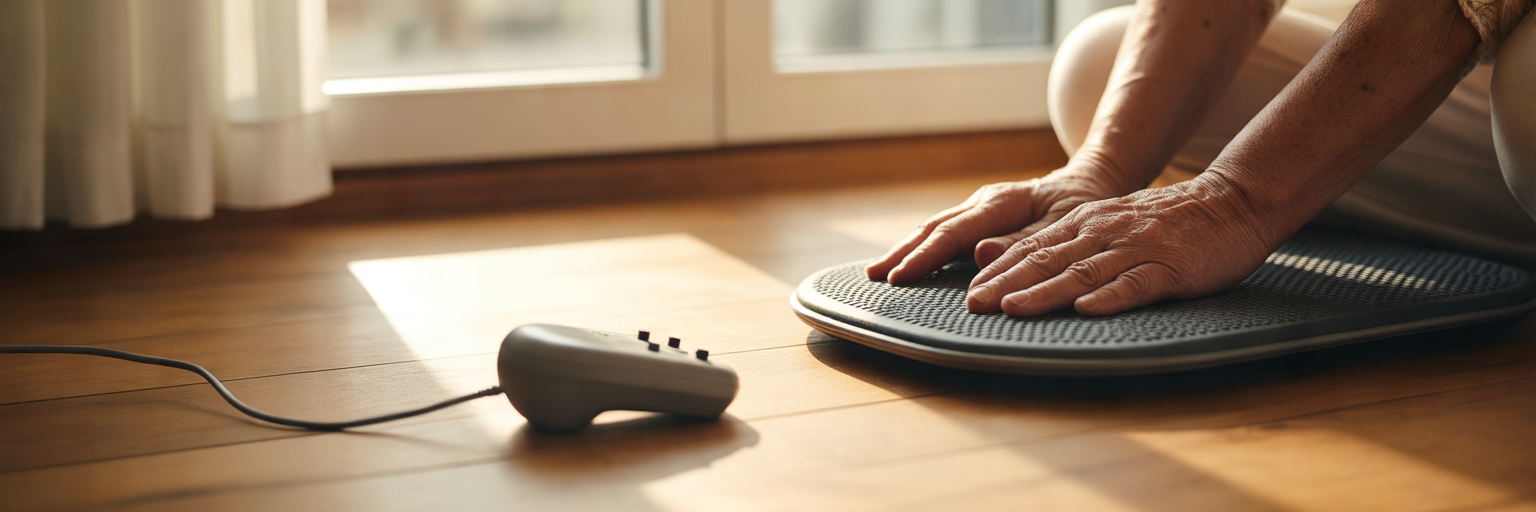
A frequent trap you will encounter when reading PEMF mat reviews involves brands advertising an enormous theoretical frequency sweep, such as 1 to 10,000 Hz, on their sales page. When you actually unbox the unit and look at the physical handheld controller, you often discover it only gives you four or five locked preset buttons with no way to dial in a specific Hertz setting. Before spending thousands of dollars, always look closely at photographs of the controller interface to verify whether you can manually select individual frequencies and step down the Gauss intensity on days when your joints feel particularly reactive. Remember that electromagnetic cellular conditioning is cumulative, meaning twenty minutes of gentle, consistent daily pulsing will always beat an occasional high-intensity blast.
Matching Mat Form Factors to Your Daily Routine
Specifications on a screen mean very little if the physical mat is too awkward to use in your actual living space. Full-body mats generally measure around 180 to 190 centimetres in length and require a dedicated stretch of carpet, a wide lounge, or a spare bed where they can lie completely flat. They make the most sense when you are dealing with widespread systemic ache, multi-joint arthritis, or fragmented sleep that benefits from immersing your entire spine and legs in a uniform field. Conversely, if your discomfort is strictly concentrated in your lower lumbar spine, hips, or neck, a compact pad such as the portable design featured in our HigherDOSE PEMF Go Mat listing can sit permanently on your study chair or favourite armchair, delivering targeted relief while you read or answer emails.
Consider the heavy reality of daily storage before choosing a full-sized system. Many premium multi-therapy mats packed with crushed stones and heavy gauge wiring weigh between fifteen and twenty-two kilograms. If your living setup requires you to unplug a twenty-kilogram mat, fold its stiff panels, and lug it into a hallway linen cupboard after every single session, human nature guarantees that you will stop using it within a month. The households that see genuine long-term mobility gains are the ones where the mat lives permanently set up on a day bed, a quiet bedroom floor corner, or an office lounge, ready to run at the push of a button five days a week.
Internal ergonomics also dictate whether you will actually look forward to lying on the equipment for thirty minutes at a time. Inside every mat sits an array of circular copper induction coils, sometimes accompanied by mesh shielding layers to block background household electrical interference. In cheaply constructed mats, those hard metal rings sit just beneath a paper-thin layer of vinyl, pressing directly into tender hip bones, shoulder blades, and the base of your spine. If lying on the mat aggravates your pressure points, your muscles will tense up against the hard surface and undo the relaxing influence of the electromagnetic pulse. Always check cross-section diagrams for high-density memory foam cushioning or quilted padding that buffers the copper coils, or confirm whether the manufacturer permits placing a thin cotton blanket or topper over the surface during use.
How Multi-Therapy Mats Compare to Thermal and Cold Systems

Many shoppers researching home recovery equipment Australia wide find themselves torn between pure electromagnetic mats and hybrid systems that stack multiple technologies into one chassis. Understanding which physical mechanism addresses your specific bottleneck prevents you from paying for layered features that might actually work against your comfort.
Layering Far-Infrared Heat with Electromagnetic Pulses
A large segment of the home market consists of hybrid mats that layer far-infrared thermal heating elements, crushed amethyst or tourmaline gemstones, and low-level red light diodes directly over the copper PEMF coils. During a bleak July winter in Melbourne or Hobart, sinking onto a gently warmed gemstone surface while pulsed fields work through stiff lumbar muscles feels deeply restorative. The conductive infrared warmth expands surface capillaries and softens rigid connective tissue, allowing the electromagnetic pulse to work on a body that is already physically relaxed.
That same heavy thermal construction can become a distinct liability during a humid February evening in Brisbane or Sydney. In cheaper hybrid mats, the infrared heating circuit and the PEMF circuit are wired together, or the dense gemstone layer traps body heat even when the thermostat is turned down. If your chronic pain carries an inflammatory, heat-sensitive edge or if warmth disrupts your evening sleep architecture, lying on a heat-retaining stone mat can leave you restless and flushed. We break down how to weigh deep thermal sweating against gentle electromagnetic pulsing in our comparison of an infrared sauna blanket versus a PEMF mat, helping you decide whether you need separate controls for heat and magnetic output.
When Cooling or Photobiomodulation Fits Better Than a Mat
No single recovery tool resolves every physical complaint, and sometimes a mat is simply the wrong instrument for the job. When your discomfort stems from acute post-exercise joint swelling, hot inflammatory flare-ups, or evening heat intolerance that keeps your core temperature elevated at night, adding a warming mat will only amplify vascular congestion. For night-time overheating and surface nerve agitation, passive cooling fabrics such as Ice Blankets help draw excess warmth away from the skin so your nervous system can settle. When the problem is acute tendon or joint inflammation after heavy training or yard work, targeted cold water immersion through a dedicated system like Plunge Chill triggers rapid vasoconstriction and calms tissue swelling in a way electromagnetic coils cannot replicate.
Other times, slow tissue repair and lingering morning heaviness have less to do with local mechanical guarding and more to do with internal metabolic bottlenecks. If your cells are struggling with low iron, vitamin D insufficiency, elevated systemic inflammation markers, or sluggish thyroid function, external electromagnetic pulsing will only take you halfway. Pairing physical recovery hardware with comprehensive blood biomarker tracking through a service like Mito Health lets you see what is happening inside your biochemistry, ensuring your body actually has the raw nutritional and hormonal building blocks required to act on the recovery signals your mat provides.
Safety Boundaries and Evaluating Ownership in Australia
Before committing your budget to any electromagnetic device, you must account for strict physiological safety boundaries. Because a PEMF therapy mat induces micro-currents inside conductive pathways, anyone with an implanted electronic medical device, including a cardiac pacemaker, implantable defibrillator, cochlear implant, intrathecal pain pump, or continuous insulin pump, must avoid these systems completely. The magnetic field can interfere with device telemetry or pacing logic. Likewise, pulsed electromagnetic systems are contraindicated during pregnancy, for individuals with active bleeding disorders, or for those living with seizure disorders such as epilepsy. Note that most non-magnetic titanium joint replacements, such as standard hip or knee prostheses, are generally compatible with low-intensity fields, though you should always clear home equipment use with your orthopedic specialist or GP first. A home recovery mat is designed to support daily comfort alongside clinical diagnosis and progressive physiotherapy, never to replace proper medical evaluation.
Once you have cleared the physical safety checks, evaluating the best PEMF mat Australia has available comes down to local ownership logistics. Spending between $500 and $5,000+ on heavy electronics requires looking closely at how the brand operates in the Southern Hemisphere:
- Native 230V/50Hz Australian power compatibility: Verify that the control box is engineered specifically for Australian mains voltage and ships with a certified Australian plug, rather than relying on a cheap 110V North American step-down transformer that can overheat, hum loudly, or distort the pulsed waveform.
- Verifiable regulatory documentation: Look for transparent compliance credentials, such as inclusion on the Australian Register of Therapeutic Goods (ARTG) via the TGA or a traceable FDA registration number, rather than generic self-created quality badges pasted onto a website footer.
- Return shipping economics on heavy parcels: Check where the return warehouse is physically located before buying a trial unit, because couriering a twenty-kilogram mat back to North America or Europe at your own expense can easily exceed $350 to $500 in freight charges.
- Local controller and mat warranty servicing: Confirm whether faulty hand controllers or wiring looms are replaced from an Australian distribution centre or if a warranty claim leaves you waiting eight weeks for overseas sea freight.
Finding the right system means matching the waveform, cushion ergonomics, and controller flexibility to the exact way your body experiences tension and the space you have available at home. Rather than rushing into the loudest brand on social media, take the time to review the technical specifications in our directory of PEMF therapy mats and compare at least three suitable models side by side so you can invest with clarity and confidence.